
What Are Storylets?
New to the idea? Start here. This page is about storylets as a way of building interactive stories - no tool, no engine, just the idea. Once it clicks, Core Concepts shows how Storylet Studio puts it to work.
You've probably played storylet games without knowing the word. Fallen London, King of Dragon Pass, Wildermyth, Reigns, 80 Days - none of them run off a single fixed script. They tell their story in small, rearrangeable pieces, handed to the player when the moment is right.
A chunk of story with a condition on the front
A storylet is a small, self-contained piece of narrative - a scene, an encounter, a moment - with a rule stuck on the front saying when it's allowed to appear. The rule is really just an if: show this when such-and-such is true.
Think of a deck of cards. Every storylet you write is a card in the deck. When the game wants some story, it doesn't shuffle the lot and hope - it deals you a hand of only the cards that are valid right now. You play one, and the next hand might look completely different.
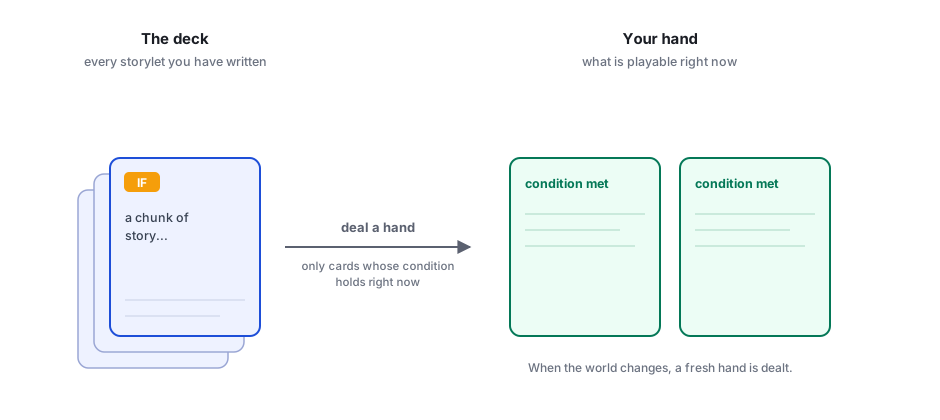
That's the whole trick: a chunk of story with a condition on it, dealt only when it fits.
The world keeps score
The conditions are checked against the state of the world - the facts your story keeps track of. Has the player met the blacksmith? How much gold are they carrying? Is it winter? Is the gate open? You decide what's worth tracking, and you give each fact a name.
Most storylets change those facts when they play. Win the duel, a flag flips. Pay the toll, the gold drops. Since the next hand is dealt against the new state, the story always keeps up with what just happened. Deal, play, the world shifts, deal again. That's the loop.
Same pieces, different shapes
Because every storylet carries its own condition, the same pile of cards can make very different stories:
- Linear - a straight chain, each beat unlocking the next.
- Parallel - several threads at once, so the player nudges a romance, a feud, and a missing-person case along a bit at a time.
- Interwoven - those threads talking to each other, so a choice in one opens or closes a beat in another.
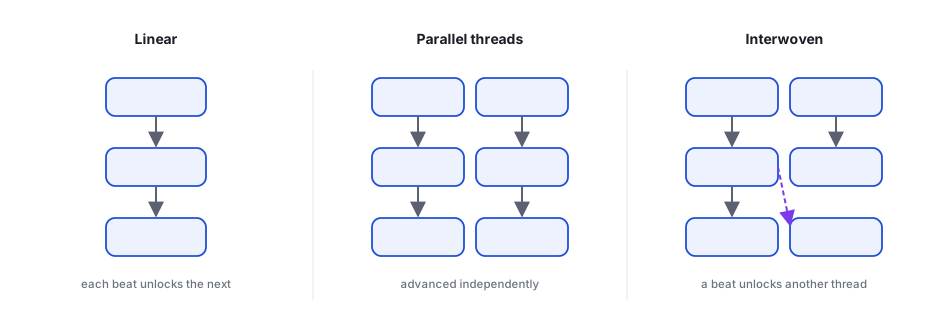
The craft is in the conditions: write them so that however the player wanders through, it still reads like a story and not a heap of scenes.
Cards that stick around, or don't
A beat shouldn't always behave the same once it's been played:
- One-shot - plays once and it's gone. Your big plot turns.
- Repeating - comes back whenever its condition holds again. Ambient flavour, recurring faces.
- Cooldown - available again, but only after a while, so it can recur without hogging every hand.
Priority
When more cards are eligible than there's room for, priority sets the running order. Give the big moment - the dragon finally turning up - a high priority and it pushes to the front the instant its condition is met, ahead of the everyday stuff.
Content that fits the player
Conditions don't just gate the plot, they tailor it. The same moment can land differently for a warrior than a thief, in winter than in summer, for a player who's been generous than one who's been a menace - you just write storylets whose conditions key off those facts. Everyone gets the version that fits, and it reads as though it were written for them.
Why build it this way
A few things come for free:
- It grows cleanly. New content is just new cards with the right condition on the front - a seasonal event, a new character class, a whole new region - dropped in without disturbing what's already there.
- You can test it in pieces. Each thread stands on its own.
- It stays honest. Eligibility is explicit, so the game only ever offers something that makes sense right now.
Open, reactive, ever-growing stories that still hang together. That's the appeal.
Where to next
- Core Concepts - how Storylet Studio puts this to work: storylets, decks, sites, properties, conditions, and the draw and play loop.
- Getting Started - install or sign in, open a sample, build your first storyworld.
- For Game Developers - if you're here to drop a finished storyworld into a game.